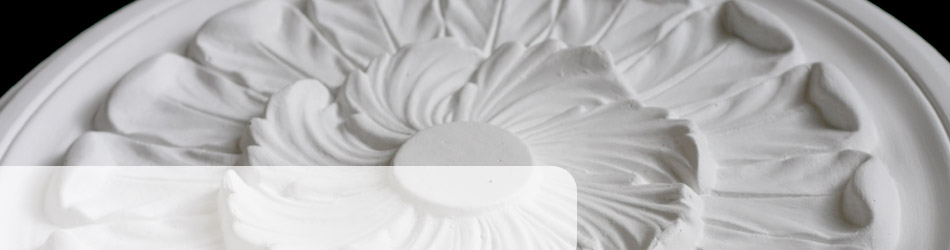
Fibrous plaster is rough and is composed of plaster laid upon a backing of canvas stretched on wood. It is typically used for mouldings, circular and enriched casings to columns and girders and ornamental work, which, being worked in the shop and then nailed or otherwise fixed in position, saves the delay often attendant upon the working of ornament in position. Fibrous Plaster is the principal form used today for cornices and other fine decorative work and mouldings.
The various forms of plaster work, from hand modelled stucco to glass reinforced gypsum may all contain some kind of fibre for strength, and most lime mortar ceiling work contains enough animal hair to bind the plaster together between the lath, contributing to its flexible strength and therefore its characteristic longevity. However, most lime plaster is run or spread in situ, and enrichments which may be added are usually small solid casts stuck to the background with a 'slip' of mortar, rather than cast in large sections. This is the type of work usually referred to in the trade as 'solid'.
The technique of reinforcing gypsum plaster with hessian or canvas has been known and used for thousands of years, and probably predates the Pharaohs. Millar, writing in 1897, mentions mummers' masks found in Kahun dating from 4,500 years ago. |
|
The modern use of this material may be said to have started then, but the use of fibrous plaster was known and practiced by the Egyptians long before the Christian era; for ancient coffins and mummies still preserved prove that linen stiffened with plaster was used for decorating coffins and making masks.
Cennino Cennini, writing in 1437, says that fine linen soaked in glue and plaster and laid on wood was used for forming grounds for painting. Canvas and mortar were in general use in Great Britain up to the middle of the last century. This work is also much used for temporary work, such as exhibition buildings. However, modern fibrous plaster work in England can be said to date from Leonard Alexander Desachy's patent of 1856, which drew on a Parisian recipe. |
|
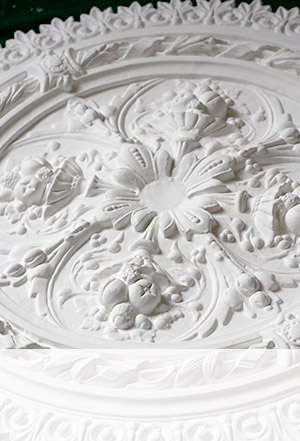
| Beautiful centre flowers complement all home interiors |
 |